
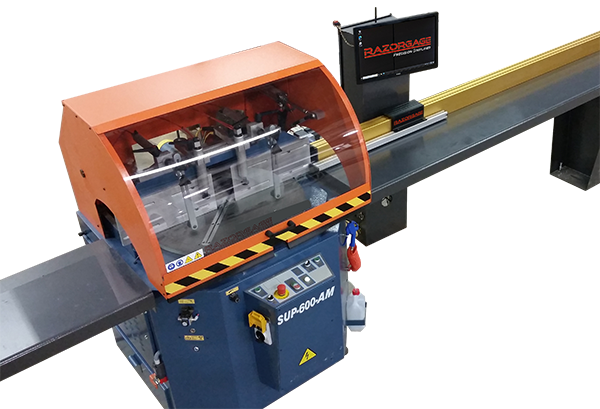
It’s about cutting accurately, quickly and in a repeatable manner when working in metal fabrication. When cutting materials at angles, manufacturers require repeatable results from their equipment while maintaining the highest operational efficiency. The RazorGage AngleMaster is a precursor to the automated angle cutting revolutionization, enabling all fabricators to achieve their projects’ specifications without the compromise of throughput or quality.
The Modern Angle Cutting Technology
Traditional angle cutting also tends to waste materials, result in bad cuts and labor costs. Each piece must be measured, adjusted, and checked before the actual cut is done, and this is not usually a quick process and is prone to error, especially when a production run is long and fatigue sets in.
Automated angle cutting systems have been developed by merging controls that are digital with mechanized precisions. These systems will allow an operator to put a specification a single time, and it might be a hundred or a thousand or two thousand pieces, absolutely identical but with very little variation. The technology has given a new face to all fabrication shops in terms of handling complex businesses of cutting with decreased setup time and increased overall lot capacity.
Key Aspects Propelling Manufacturing Excellence
Advanced positioning systems have components that are critical and work hand in hand. Digital readouts display, in real time, positioning accuracy for the operator to confirm settings before initiating production runs. There are also servo motor controls that effect smooth, precise movement, which can be repeated consistently for entire production batches.
Simpler handling of materials from heavy support forces that accommodate various lengths and weights has now made it possible for a single person to move heavy structural materials that, in the past, had to be positioned by several men. This not only improved safety standards but also enabled shops to redistribute labor for various other tasks to be done.
The way of modern cutting operations heavily relies on software interfaces. The programming is straightforward to the extent that even the not-so-experienced operators would quickly set up involved cutting sequences with ease. Systems of pattern storage mean instant recall of frequently used configurations, avoiding redoing set-up procedures and minimizing risk for input mistakes.
Improving Production in a Shop
Production efficiency is not just a speed gain over other systems. Much downstream benefits accrue once every cut is done right the first time. Welders, assemblers, and finishers work with components that fit together well, requiring much less rework, in addition to taking less assembly time. The ripples created throughout the production process greatly magnify the initial time saved in cutting.
The other serious “saving” relates to material optimization. The precision systems of cutting would determine the most economical way to “use up” raw materials by intruding into the production of scrap and maximizing every piece of stock. Over the years, these savings have proved “huge,” especially for shops processing their most costly materials such as stainless steel or aluminum alloys.
Equipment would maintain common accuracy and therefore quality control could be easier. Rather than inspection of each piece, operators could install a statistical sampling protocol with the feeling that the system will produce uniform results. Saved are the inspection days, still maintaining a very rigid quality standard.
Versatility Across Sectors
Every industry has its unique requirements when it comes to cutting equipment. Structural steel fabrication is usually in context with heavy beams and channels, at angles compound. Architectural metalwork has a great deal of intricacy built into its designs, using a lot of decorative elements that require both precision and repeatability. Custom builders would still require flexibility in moving between very diverse projects without the need for exhaustive reconfiguration.
Adaptive angle-cutting systems have their own programmable settings and modular configurations that answer those different needs. Quick-change tooling provides instant switching between different material types and thicknesses. Adjustable fences and stops can accommodate those inexplicable dimensions without special fixtures or a great deal of manual set-up.
Memory storage for several job configurations proves invaluable for shops often handling repetitive work. When a customer places a repeat order, the operator needs only to recall the program saved and start production right away. This capability reduces lead time significantly and boosts customer satisfaction by improved turnaround.
Investment Considerations in the Fabrication Shop
Evaluating equipment cost into an investment is really about short-term charges and then long-term worth. Automated systems cost a lot because they are very capital-intensive but return in various streams. The labor cost during production reduces immediately since a reduced number of workers produce a greater output. The savings in materials become cumulative with the project, and some alloy processing is astonishing noticeable.
The benefit that competitive advantage often provides is the greatest advantage. A job requiring tight tolerances unattainable through manual operation could be darted to by shops with precision automation. This would yield new opportunities in the market. Further, the businesses would continue reaping premium pricing for their high-quality, consistent offerings.
Training requirements should be factored into implementation planning. Modern systems with user-friendly interfaces minimize the learning curve, but allocating adequate time for operator familiarization ensures optimal utilization. Most manufacturers find that comprehensive initial training prevents costly mistakes and accelerates the path to full productivity.
Maintenance and Longevity
Industrial equipment longevity depends heavily on proper maintenance protocols. Regular inspection of mechanical components prevents unexpected failures that could halt production. Lubrication schedules should be followed meticulously to ensure smooth operation and extend component life. Digital systems require periodic calibration to maintain accuracy standards over time.
Establishing preventive maintenance routines costs far less than emergency repairs. Scheduled downtime for servicing can be planned around production schedules, minimizing impact on delivery commitments. Keeping detailed maintenance records helps identify wear patterns and predict component replacement needs before failures occur.
Software updates occasionally become available to enhance functionality or address operational issues. Staying current with these updates ensures equipment continues performing at peak capability and may provide access to new features that further improve productivity.
Conclusion
Manufacturing excellence demands tools that deliver precision, reliability, and efficiency. Modern automation technology has transformed angle cutting from a labor-intensive process into a streamlined operation that maximizes productivity while minimizing errors. Whether handling structural steel, architectural components, or custom fabrications, the right equipment enables fabrication shops to meet demanding specifications consistently. The RazorGage Positioner technology represents the kind of innovation that helps manufacturers remain competitive in an industry where accuracy and efficiency determine success.
Frequently Asked Questions
What materials can be processed with automated angle cutting systems?
These systems handle a wide range of metals including carbon steel, stainless steel, aluminum, copper, and various alloys. Material thickness capacity varies by model, but most professional-grade equipment accommodates everything from thin sheet metal to heavy structural sections.
How difficult is it to train operators on automated cutting equipment?
Modern systems feature intuitive interfaces designed for ease of use. Basic operations can typically be learned within a few days, while mastering advanced features may take several weeks of regular use. Most operators with general fabrication experience adapt quickly to digital control systems.
What kind of accuracy can be expected from precision cutting systems?
Professional-grade equipment routinely achieves accuracy within thousandths of an inch. This level of precision ensures components fit together properly during assembly and meet engineering specifications for structural applications.
How does automation affect production capacity?
Shops typically see production increases of fifty to two hundred percent depending on the application and previous methods used. The combination of faster cycle times, reduced setup requirements, and elimination of measurement errors contributes to these substantial gains.
What space requirements should be considered for installation?
Equipment footprint varies based on capacity and configuration. Beyond the machine itself, adequate clearance for material infeed and outfeed is essential. Most installations require between fifteen and thirty feet of linear space, though compact models suit smaller workshops.
 neharajput
  harshali1
  kmkventuresusa