
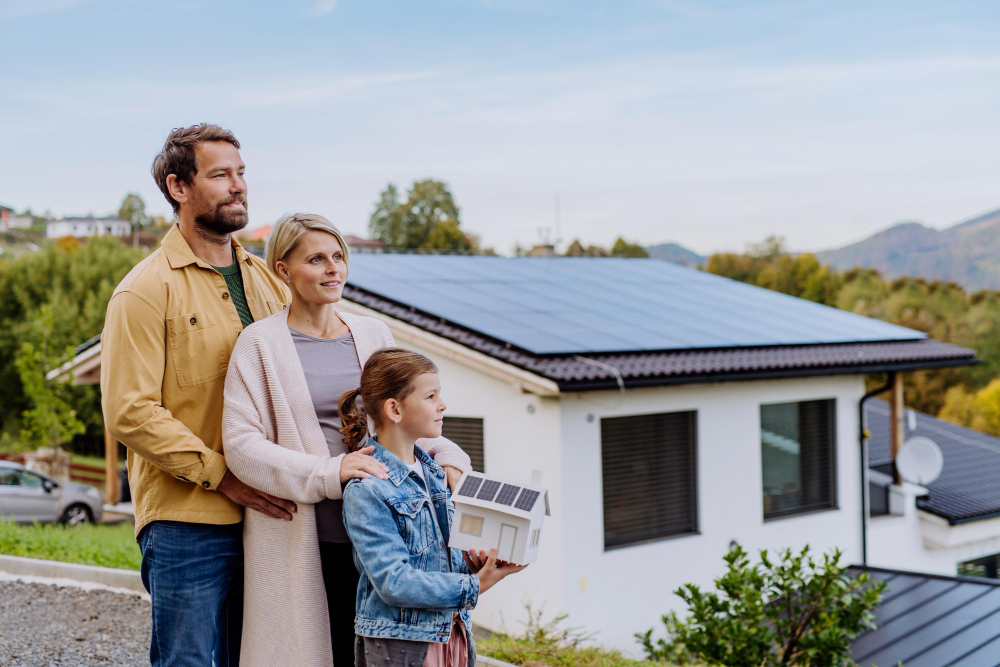
Not only will switching to solar energy for your home save you money, but it will also help you live in a cleaner, more sustainable way. India’s electricity costs are going up, so more people are looking to solar power as a safe, cheap, and environmentally friendly option.
To help you decide if solar power is right for your family, we’ll explain how it works, how much it costs, and how the government can help you pay for it.
How does solar power for your home work?
Using solar panels to collect sunlight and turn it into power for your home is what it means. Photovoltaic (PV) cells in these panels, which are usually put on roofs, make electricity. After that, you can use the energy to power your lights, appliances, and even air conditioners.
When you connect your system to the grid, you can send any extra power back to the grid through net metering. This will lower your energy bills even more. Off-grid solutions, on the other hand, use batteries to store energy and are great for places that are far away.
Why more Indians are picking solar power
- High power bills? Solar can cut your monthly costs by 70% to 90%.
- Government programs like the PM Surya Ghar Yojana make it possible for people to buy it.
- Living in an eco-friendly way lowers your carbon footprint.
- Power panels last 20–25 years, so they are a safe long-term investment.
- Energy independence means not having to count on power outages or changing prices as much.
How solar power works for homes
- Solar panels: put on your roof to collect sunlight.
- Direct Current (DC) is changed into Alternating Current (AC), which your home products use, by an inverter.
- Net meters keep track of how much electricity you use and how much you send back to the grid.
- Battery (optional): This stores extra power for use as a backup in hybrid or off-grid setups.
This is essentially the same technology powering large solar electricity for homes projects across India.
Types of Solar Systems for Homes
When you consider Solar Power Panels for Home, you’ll likely choose between three system types:
- On-grid: Most popular and affordable, connected to the utility grid.
- Off-grid: Independent, requires batteries.
- Hybrid: Mix of both, with storage and grid support.
Cost of Solar Energy for Homes in India
The Solar Panels and Cost factor is one of the biggest considerations. Here’s a simple breakdown (approximate 2025 pricing):
- 1kW system: ₹75,000 – ₹85,000 (suitable for a small home, runs lights/fans)
- 3kW system: ₹1,50,000 – ₹1,70,000 (ideal for a family home, runs AC, TV, fridge)
- 5kW system: ₹2,50,000 – ₹3,00,000 (larger homes with high consumption)
With subsidies, prices can drop by 30–40%, making solar affordable for middle-class families.
How Solar Energy Adds Value to Your Home
Just like Solar Power to House discussions highlight, solar isn’t just about saving money—it increases property value. Homes with solar panels sell faster and at better prices because buyers see them as future-proof.
Maintenance and Lifespan
One of the best parts of solar is that it requires minimal maintenance:
- Cleaning panels every 15–30 days
- Occasional inspection of wires and inverter
- Monitoring via mobile apps
Most panels come with 25-year warranties, making them a worry-free investment.
Premium solutions like sunpower solar panels are also gaining popularity for their high efficiency.
FAQs
- Q1: How many solar panels are required for a 2BHK house?
A: Typically, a 2–3kW system (6–9 panels) is enough for average use. - Q2: Do solar panels work during cloudy days?
A: Yes, though efficiency drops slightly. Hybrid systems with batteries are ideal in such conditions. - Q3: What’s the payback period of a home solar system?
A: Usually 4–6 years, after which savings are essentially free electricity. - Q4: Can I run heavy appliances on solar?
A: Yes, with the right system size, solar can run ACs, washing machines, and refrigerators. - Q5: Do I need special permission to install solar?
A: For on-grid systems, approvals are needed from DISCOM, which contractors handle for you. - Q6: How long does installation take?
A: Most residential projects are completed within 5–7 days. - Q7: Can solar panels be moved if I change houses?
A: Yes, they can be dismantled and reinstalled, though some cost will apply. - Q8: Are batteries compulsory for home solar systems?
A: No, only off-grid or hybrid systems need batteries. On-grid systems don’t. - Q9: Is solar energy for homes safe?
A: Absolutely. Panels are tested for safety, and inverters regulate current. - Q10: Will solar energy lower my carbon footprint?
A: Yes, significantly. A 5kW system offsets around 6–7 tons of CO2 annually.
Final Thoughts
Switching to solar energy for your home is one of the smartest financial and environmental decisions you can make in 2025. It lowers your electricity bills, increases your property value, and reduces dependency on the grid—all while helping fight climate change.
With falling panel prices, government subsidies, and reliable Solar Energy Contractors, there’s never been a better time to go solar.
Follow Digital24hour for more
 akappliancerepair